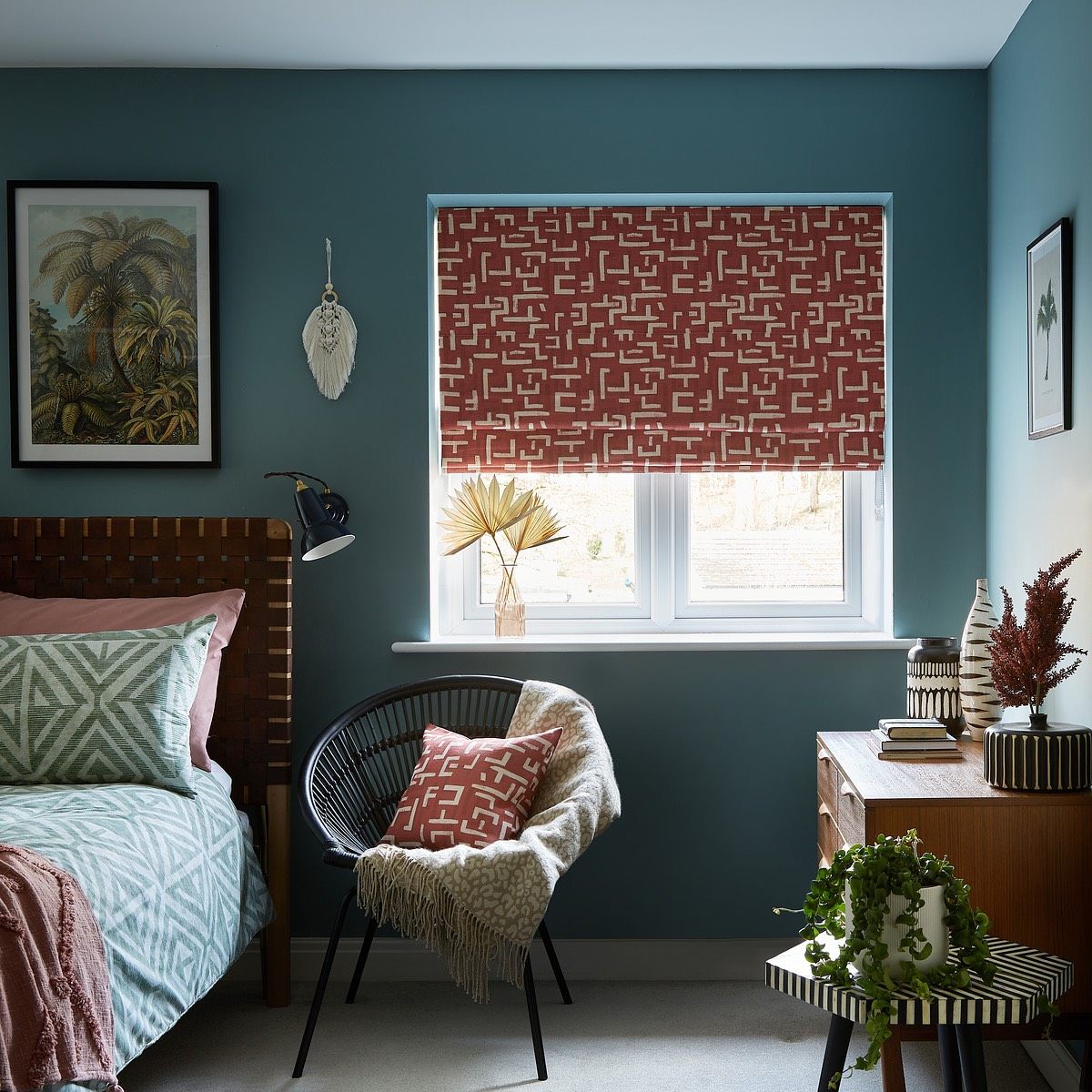
The soft furnishing look, without curtains
A roman blind is a panel of furnishing fabric with horizontal rods sewn in across its width. Raise it and the fabric concertinas into generous folds that sit in a neat stack at the top of the window; lower it and you get a smooth, tailored drop of fabric. It's the closest a blind comes to the warmth of curtains, but without the bulk at either side of the window — a real advantage on smaller windows and in cosy rooms.
Each one is sewn to your window's exact dimensions, hung on a sidewinder-operated headrail, and installed by our own fitters under our 12-month guarantee.
Fabrics, linings and the blackout question
Because romans are made from furnishing fabric, the choice is glorious: textured weaves, linens, plains, geometrics and prints, in everything from muted heritage shades to bold pattern. All of it comes to your house in sample books, so you can drape a fabric against your sofa and cushions before deciding.
The lining matters as much as the face fabric:
- Standard lining protects the face fabric from sun-fade, gives the folds body and makes the blind hang beautifully.
- Blackout lining turns a roman into a genuinely effective bedroom blind, stopping light passing through the fabric itself. Our blackout blinds guide explains how lining, fit and fitting position combine for the darkest result.
Dimout and flame-retardant options are available where a room or setting calls for them.
Rooms where a roman blind belongs
Romans are at their best where comfort is the point of the room:
- Living rooms — a lined roman softens the acoustics, frames the window and adds a layer of colour or pattern you simply can't get from a hard blind.
- Bedrooms — with blackout lining, they pair a hotel-finish look with proper darkness for sleep.
- Dining rooms and snugs — lowered on a winter evening, a heavy-lined roman makes a room feel instantly warmer and more enclosed.
- Studies and halls — anywhere a bare window feels cold, a roman dresses it.
The one place we'd steer you away from them is a steamy kitchen or bathroom, where moisture and fabric don't mix — a wipeable roller blind or a venetian is the smarter pick there.
Warmth you can feel, not just see
A lined roman is one of the more insulating blinds you can hang. Two layers of fabric — three with an interlining effect from the folds — trap a cushion of air against the glass, which helps rooms hold their heat on cold nights. In the many solid-walled terraces and older semis around Mansfield and Sutton-in-Ashfield, where windows can be the draughtiest part of the room, that extra layer earns its keep every winter. Lower the blinds at dusk and you'll notice the difference.
Made properly, fitted properly
A roman blind lives or dies by its measurements — a centimetre out and the folds sit wrong or light leaks at the edges. Here's how we make sure yours is right:
- Home consultation, free of charge — fabric books out, linings explained, and every window measured by someone who does it daily.
- A clear written quote — fitting included, nothing to sign on the day, no obligation at all.
- Sewn to size — pay a 50% deposit and your blind is made up over roughly two to three weeks.
- Installed and dressed — our fitters hang the blind, set the folds so they stack evenly, and show you the smooth way to raise and lower it.
Roman or roller? A fair comparison
Both cover the window with fabric, so which should you pick? Choose a roman when the look of the room is the priority: the folds, the lining and the fabric depth give a decorated, upholstered finish that a flat blind can't imitate. Choose a roller when budget, wipeability or minimalism lead — it's simpler, slimmer and less expensive. Many of our customers mix the two through the house: romans in the lounge and bedrooms, rollers in the kitchen and bathroom. Our room-by-room guide maps it all out, or ask us to talk it through at your free visit — call 01623 325 054 or get in touch.
Frequently asked questions
Are roman blinds good for keeping a bedroom dark?
With a blackout lining, yes — the lining stops light passing through the fabric, and because the blind is made to your window's exact size, edge gaps are kept small. No blind mounted inside a recess achieves total blackout on its own, so if you need near-darkness for shift work or young children, we'll advise on fitting the blind outside the recess for maximum coverage.
Can I have a roman blind in my kitchen or bathroom?
We'd generally advise against it. Steam and condensation gradually mark and misshape furnishing fabrics, and a roman's folds hold moisture longer than a flat blind. In wet or steamy rooms you'll get far better service from a splash-proof roller, an aluminium venetian or a faux-wood venetian, and you can keep romans for the living spaces.
Do roman blinds help insulate a room?
Noticeably, yes. A roman with a quality lining puts two layers of fabric and a pocket of trapped air between the room and the glass, which slows heat loss through the window on cold evenings. In older Mansfield homes with single glazing or draughty frames, lowering lined romans at dusk makes a real difference to how warm a room feels.
How do roman blinds compare with curtains?
A roman gives you a similar softness and fabric presence but in a much tidier footprint — there are no bulky stacks either side of the window, which suits smaller rooms and window seats. Blinds also use less fabric than full-length curtains, and the tailored folds have a smarter, more structured look. It comes down to taste; many rooms suit either.
How long does a made-to-measure roman blind take?
Around two to three weeks from order to installation is typical, as each blind is cut and sewn to your window's measurements. The process starts with a free home consultation where we measure and quote, you confirm with a 50% deposit, and our own fitters install the finished blind and set the folds. Everything is covered by a 12-month guarantee.