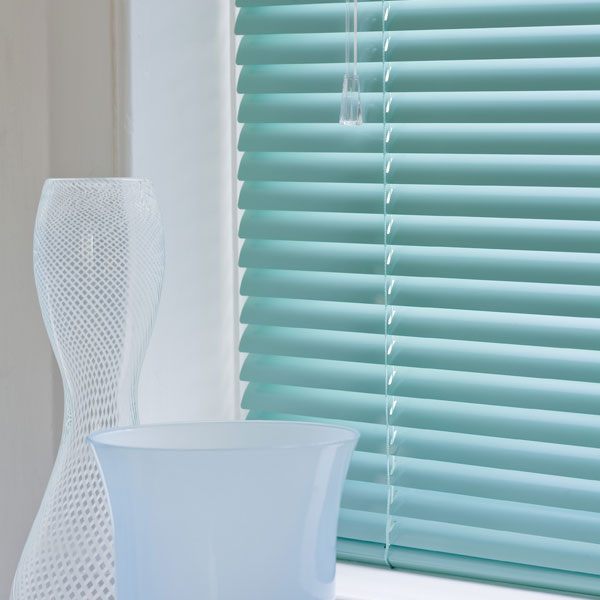
How a venetian blind works
Venetians are built from horizontal slats threaded on ladder cords. Rotate the slats with the tilt control and you move smoothly from fully open to fully closed, with every angle in between. Raise the blind and the slats stack into a compact bundle at the top of the window, leaving the glass almost completely clear.
That tilting action is the whole appeal. A roller blind is either up or down; a venetian gives you dozens of positions in between, so you can knock back low winter sun over the sink or stop passers-by seeing in, all while daylight keeps coming through. Ours are made to measure, fitted by our own installers and covered by a 12-month guarantee.
Aluminium venetians: the workhorse of wet and busy rooms
This page is mainly about metal venetian blinds — slats of finished aluminium that are light, rigid and completely unbothered by moisture. That last point matters: steam from a hob or a shower will eventually warp untreated timber and stain ordinary fabric, but aluminium simply doesn't care. Wipe the slats down and they look new again.
They're available in a broad palette, from crisp whites and soft neutrals through to bold statement colours and metallic finishes, with a choice of slat widths to suit the scale of the window. Narrower slats give a fine, delicate look on small windows; wider slats feel bolder and are quicker to dust.
The rooms where venetians shine
- Kitchens — steam-proof, wipeable and precise, an aluminium venetian handles life above a worktop better than almost anything else.
- Bathrooms — full privacy with the slats closed, ventilation-friendly light with them tilted, and no fabric to hold on to damp.
- Home offices — angle the slats and screen glare vanishes while the room stays bright; a real advantage if you work from home in Mansfield or Kirkby-in-Ashfield.
- Workplaces — hardwearing and easy to keep uniform across a run of windows; for bigger premises see our commercial blinds page.
For bedrooms and lounges, where warmth and softness tend to matter more than wipeability, it's worth weighing venetians against roman blinds or a blackout roller before you decide.
Prefer the look of wood? You have two options
If you like horizontal slats but want the warmth of timber rather than the crispness of metal, we also supply wooden venetians in real basswood and faux-wood venetians that carry the same look in a moisture-resistant material. Faux-wood is the clever answer for a kitchen or bathroom where a real-wood blind would suffer. Both are covered in detail on our wooden venetian blinds page, and we bring samples of all three materials to every consultation so you can compare them side by side.
Keeping a venetian looking sharp
Slats collect dust — there's no pretending otherwise — but keeping on top of it takes minutes, not hours. Tilt the blind almost closed and run a duster or the soft brush of a vacuum along the slats, then tilt the other way and repeat. Aluminium slats can also take a wipe with a damp cloth whenever they need it. A little routine goes a long way; our cleaning and care guide has the full method, including how to deal with kitchen grease.
Measured, made and fitted — the easy way
Book a free home visit and we'll do the rest: sample cases open on your table, every window measured properly, and a written quote that includes the fitting. There's no obligation and no follow-up pestering. If you go ahead, a 50% deposit puts your blinds into production, they arrive in around two to three weeks, and our fitters hang them level, test the tilt and lift on each one, and tidy up after themselves. If you'd like to understand the measuring side first, our measuring guide explains recess and exact sizes in plain terms — and our room-by-room guide can help you plan the whole house in one visit.
Frequently asked questions
Are venetian blinds suitable for bathrooms?
Aluminium venetians are one of the best bathroom blinds you can buy. The slats are completely moisture-resistant, close fully for privacy and tilt open to let steam clear while keeping the window obscured. If you prefer a timber look in a bathroom, choose a faux-wood venetian rather than real wood — it gives the same effect without any risk of warping.
What's the difference between venetian and vertical blinds?
Both use tilting slats, but venetians run horizontally and suit standard-height windows, while verticals hang vertically and suit wide openings like patio doors. If you're covering a kitchen or bathroom window, a venetian is usually right; for a large window or door opening, a vertical usually makes more sense. We're happy to advise at your free consultation.
Do venetian blinds block out light at night?
With the slats closed they cut light substantially and give you full privacy, but small amounts of light can still creep between slats and around the edges, so a venetian is not a true blackout solution. For a bedroom where darkness is the priority, we'd usually suggest pairing rooms: venetians where control matters, blackout rollers where sleep matters.
Are aluminium venetian blinds hard to keep clean?
Not really — they just need little and often rather than a big annual effort. A quick pass with a duster or vacuum brush across the tilted slats keeps dust at bay, and aluminium happily takes a damp cloth for anything stickier, which is why they work so well in kitchens. There are no fabric parts to stain or shrink.
Can you fit venetian blinds without drilling into my uPVC windows?
Yes. Venetian-style slats are available in Perfect Fit frames, which clip neatly into the beading of uPVC windows and doors with no screws or drilling at all. It's a popular choice for tilt-and-turn windows and conservatories. See our Perfect Fit blinds page or ask us to bring a sample frame to your home visit.